
Panic hardware is required on most commercial exits with 50 or more occupants. Here is the code, the common mistakes, and when to call a pro.
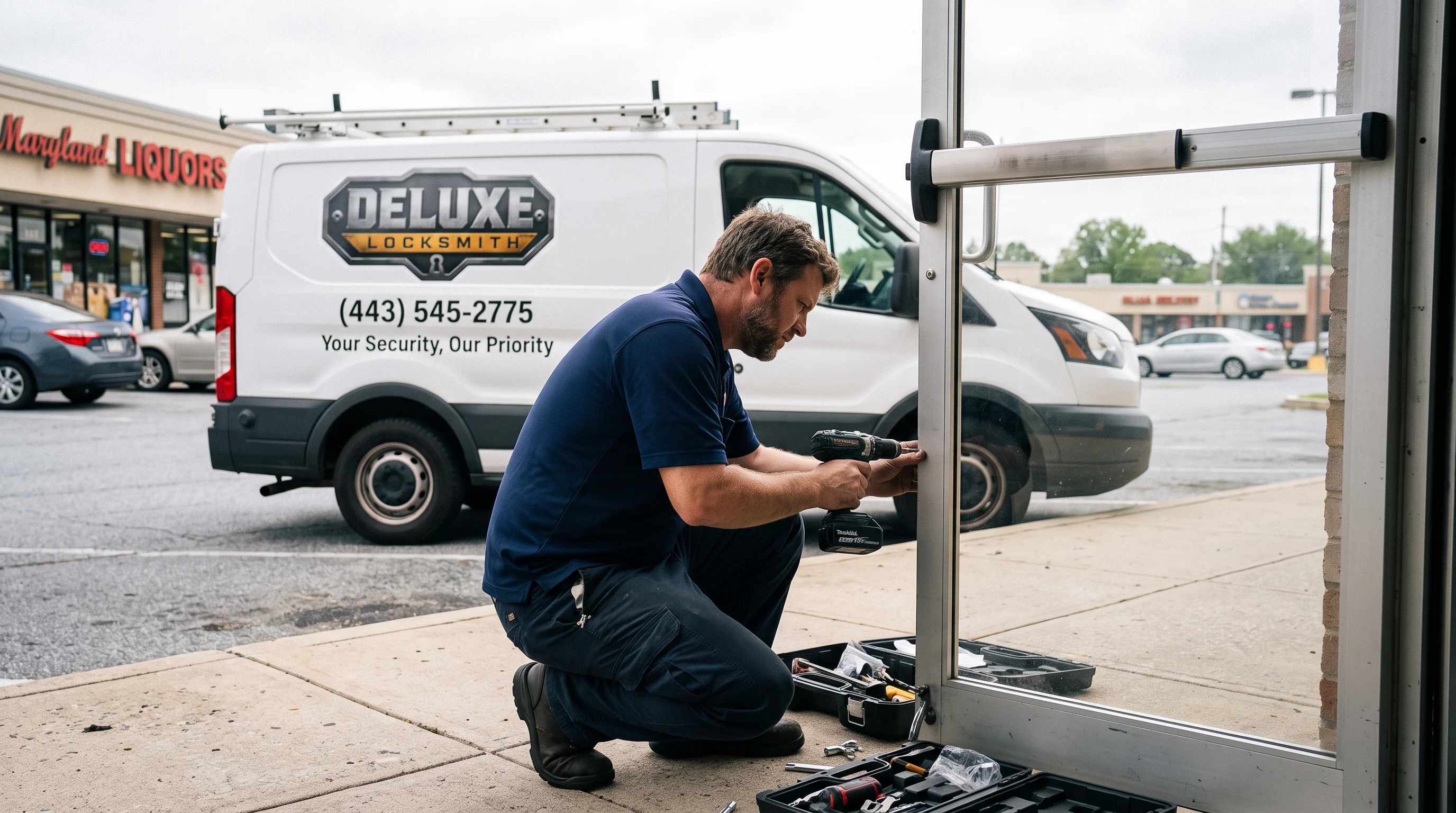
A panic bar is the bar people push to get out, and that makes it a life-safety item first and a piece of hardware second. Most Cecil County business owners assume any push bar satisfies the code. It usually doesn't. The requirements are specific, and the mistakes we see on service calls are consistent enough to be worth walking through before an inspector finds them for you.
Skimming? Here's the gist. Exit doors serving 50 or more occupants generally need panic hardware under the International Building Code. Mounting height, the fire-rated vs. standard hardware distinction, and how panic bars interact with keyless entry are the three places businesses most often get it wrong. Deluxe Locksmith installs and corrects panic hardware across Cecil County, Maryland, including Elkton, North East, and Rising Sun.
Does Your Business Need a Panic Bar?
In 2026, the International Building Code requires panic hardware on exit doors serving Assembly or Educational occupancies with a calculated occupant load of 50 or more (IBC 2024, Chapter 10, Means of Egress, International Code Council, 2024). Some spaces need it regardless of occupant load, including transformer vaults, battery and energy storage rooms, and modular data centers. That covers a surprising number of Cecil County storefronts, restaurants, and offices once you actually run the headcount.
Easy to miss: the 2024 IBC also requires panic hardware on any exit door within 25 feet of electrical equipment rated 800 amps or more, such as a main electrical room or switchgear closet, regardless of the room's occupant load (Decoded: Which doors need panic hardware?, I Dig Hardware, Allegion, 2026). Businesses with a back-of-house electrical or utility room rarely think to check this one, since it has nothing to do with staff or customer headcount. Deluxe Locksmith can check your utility and electrical rooms during the same visit as the rest of your exits, so this kind of code gap doesn't get missed until an inspector catches it.
Maryland enforces these requirements through the Office of the State Fire Marshal, operating under the Maryland Department of State Police, using the state's adopted fire prevention code (State of Maryland Fire Prevention Code, Maryland State Fire Marshal, 2024). The office has broad authority to inspect buildings and penalize violations. If you're not sure whether your building crosses the 50-occupant threshold, that's worth confirming before you assume a standard commercial lock is enough.
A retail space with two or three staff and light foot traffic might stay under the threshold. A restaurant, a fitness studio, or a multi-tenant office building rarely does once customers, staff, and peak hours are counted together. If your occupancy classification or headcount is close to the line, treat it as a question for your local fire marshal's office, not a guess.
What Actually Counts as Panic Hardware?
Panic hardware lets a door open with a single motion under simple pressure, normally latched until someone pushes the bar. A rim panic bar, where the latch mechanism sits in a case mounted on the interior door face, is the most common configuration for a retrofit because it suits most wood and hollow-metal doors without major modification (How to Install a Panic Bar, National Lock Supply, accessed 2026).
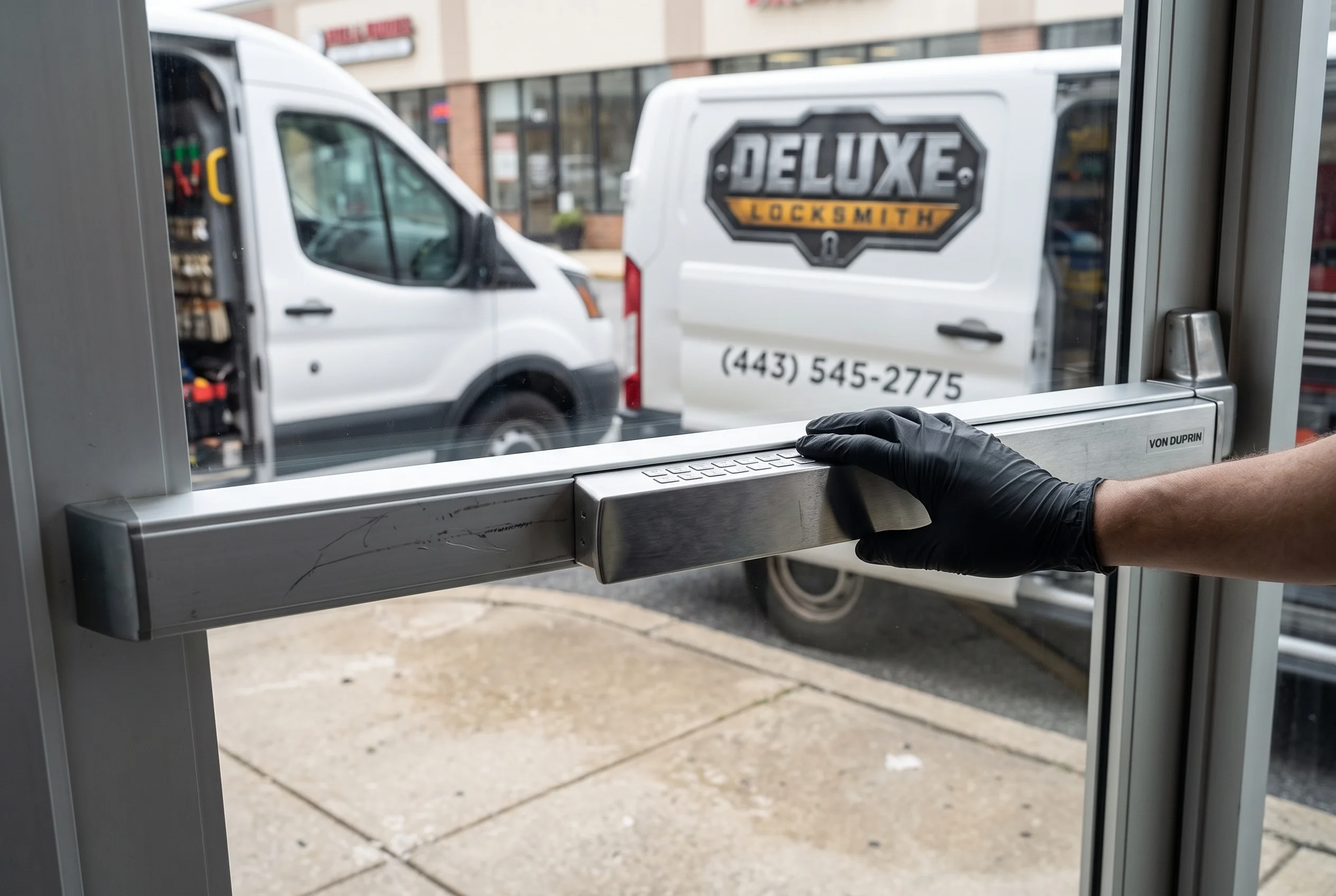
Two numbers matter more than any others. Panic hardware mounts 34 to 48 inches above the floor or threshold, and the touchpad or crossbar spans at least half the width of the door leaf (IBC Requirements for Panic Bars, Automatic Door and Hardware, accessed 2026). Both specs stay consistent across code authorities and installer guides, which is why they're the two things worth remembering even if you forget everything else in this post.
What Is the Difference Between Panic Hardware and Fire Exit Hardware?
Standard panic hardware often includes a dogging feature that lets staff hold the latch retracted during business hours, useful on a busy retail entrance. Fire-rated doors prohibit that entirely. They require UL-listed fire exit hardware that stays latched at all times, so the door can contain smoke and flame if a fire breaks out on the other side (Code Requirements for Panic Door Hardware in 2026, Vortex Doors, 2026). A business that dogs a fire-rated door for convenience isn't just breaking a rule. It's defeating the reason that door has a fire rating in the first place.
A Simple Way to Tell Them Apart
| Feature | Standard panic hardware | Fire exit hardware |
|---|---|---|
| Dogging (latch held retracted) | Often allowed | Never allowed |
| Fire rating | Not required | UL-listed, required on fire-rated doors |
| Typical use | Standard exit doors, no fire rating | Fire-rated corridor and stairwell doors |
| Common mistake | Used where fire exit hardware belongs | Rare to see the reverse |
This distinction is easy to miss because both types look nearly identical from across a room. It only becomes obvious once someone checks the door's fire rating against the hardware actually installed on it, which is exactly the kind of thing a panic bar installation assessment is meant to catch.
What Is the Keyless Entry Trap Most Businesses Don't Know About?
As of the 2024 IBC, a door required to have panic hardware can no longer have its electromagnetic lock released by a motion sensor alone. Release has to come from a switch built into the panic hardware itself, along with a loss-of-power release (What's Next? Approved changes to the 2024 IBC affecting electrified hardware, I Dig Hardware, Allegion, 2022). That rule directly affects any Cecil County business considering keyless entry on an exit door, and it's not something most badge-reader vendors bring up during the sales pitch.
If you're weighing keyless entry for convenience or an audit trail, plan the panic hardware and the access control as one project, not two. A system installed in the wrong order, or by an installer who only handles one side of it, is where this mistake usually happens.
What We Commonly Find on Service Calls
Dogged fire-rated doors are the most frequent issue: a latch held retracted for staff convenience on a door that legally can't allow it. Wrong mounting height comes next, usually from a previous DIY install or a general contractor who treated the panic bar like any other hardware line item. Incompatible strikes and closers show up too, where the panic hardware and the rest of the door's hardware were never matched to work together.
None of these are dramatic on their own. Together, they're why panic hardware that looks fine from across the room can still fail an inspection, and why a walk-through by someone who installs this hardware regularly catches problems a quick visual check won't.
Why Professional Installation Matters
Door and frame compatibility, correct hardware grade, and code-compliant mounting all have to line up for panic hardware to pass inspection. Grade 1 BHMA-rated hardware is generally what NFPA 101-compliant exits call for, and incorrect installation fails inspection even when the hardware itself is the right grade (Commercial Panic Bars & Door Closers, LA City Locksmith, accessed 2026). That's the consensus among installers who work on this hardware regularly, echoed in a trade discussion among commercial door contractors weighing panic bar options for their own jobs.
This is one of the few pieces of commercial hardware where a good-enough install isn't actually good enough. The door either releases correctly under code-required conditions or it doesn't, and an inspector isn't grading on effort.
Frequently Asked Questions
Does my business need a panic bar?
Usually yes if an exit door serves an assembly or educational occupancy with a calculated occupant load of 50 or more, per the International Building Code. Some rooms, like electrical vaults and battery storage, need panic hardware regardless of occupant load. Maryland enforces this through the Office of the State Fire Marshal, so a local inspection is the final word for your specific building.
What's the difference between panic hardware and fire exit hardware?
Standard panic hardware often has a dogging feature that holds the latch retracted during business hours. Fire-rated doors prohibit that. They require UL-listed fire exit hardware that stays latched so the door can contain smoke and flame during a fire. Installing the wrong one on a fire-rated door is a compliance failure, not a cosmetic mismatch.
How high should a panic bar be mounted?
Panic hardware is typically mounted 34 to 48 inches above the floor or threshold, and the touchpad or crossbar needs to span at least half the width of the door leaf. Those numbers stay consistent across code authorities and installer guides, which is why they're the two specs worth memorizing.
Can I add a keypad or badge reader to a door with a panic bar?
Yes, but the 2024 IBC changed how it has to work. A door required to have panic hardware can no longer have its electromagnetic lock released by a motion sensor alone. Release has to come from a switch built into the panic hardware itself, plus a loss-of-power release. That matters for any business adding keyless entry to an exit door.
Do panic bars need to be inspected?
Panic hardware on required exits typically falls under fire code inspection, since it's classified as life-safety equipment rather than ordinary door hardware. Inspection frequency and specifics vary by jurisdiction and occupancy type, so check with your local fire marshal's office for the exact schedule that applies to your building.
Getting Your Panic Hardware Checked
Not sure whether your current setup would pass inspection? The starting point is the same either way: a walk-through of the exit doors, their occupancy classification, and what hardware is currently installed. Deluxe Locksmith handles that assessment on-site across Elkton and the rest of Cecil County. If a door needs correcting, that's addressed on the same visit whenever possible.
Have your building's occupancy type and a rough headcount ready before the visit. It speeds up the walk-through. If you're also planning keyless entry on any exit door, mention that up front so the panic hardware and access control get planned together instead of as two separate jobs.
Where we do this
We cover Northeast Maryland & Delaware. If you want the detail for your own town rather than the general advice above, start here:
- Locksmith in Elkton, MD
- Locksmith in North East, MD
- Locksmith in Rising Sun, MD
- Locksmith in Perryville, MD
Need this doing rather than reading about?
Call (443) 545-2775 and describe what is happening, or send the details through the request form and we will call you back. We cover Northeast Maryland & Delaware.
Sources
- International Code Council, IBC 2024, Chapter 10, Means of Egress, retrieved 2026-09-24, codes.iccsafe.org
- I Dig Hardware (Allegion), Decoded: Which doors need panic hardware?, retrieved 2026-09-24, idighardware.com
- Maryland State Fire Marshal, State of Maryland Fire Prevention Code 2024, retrieved 2026-09-24, mdsp.maryland.gov
- National Lock Supply, How to Install a Panic Bar, retrieved 2026-09-24, nationallocksupply.com
- Automatic Door and Hardware, IBC Requirements for Panic Bars, retrieved 2026-09-24, autodoorandhardware.com
- Vortex Doors, Code Requirements for Panic Door Hardware in 2026, retrieved 2026-09-24, vortexdoors.com
- I Dig Hardware (Allegion), What's Next? Approved changes to the 2024 IBC affecting electrified hardware, retrieved 2026-09-24, idighardware.com
- LA City Locksmith, Commercial Panic Bars & Door Closers, retrieved 2026-09-24, lacitylocksmith.com
- ContractorTalk, Commercial doors with panic bars?, retrieved 2026-09-24, contractortalk.com
Deluxe Locksmith is a locally owned and operated mobile locksmith serving Elkton, MD and the surrounding Cecil County, Harford County, New Castle County, and Kent County area. Bonded and insured, with technicians dispatched directly to the job site for automotive, residential, commercial, and emergency lock and key work. Read more about the team on the About page, or check common questions on the FAQ.