
Keyless entry pays off when staff change often. Here is when it fits, when plain keys still win, and the exit door rule.
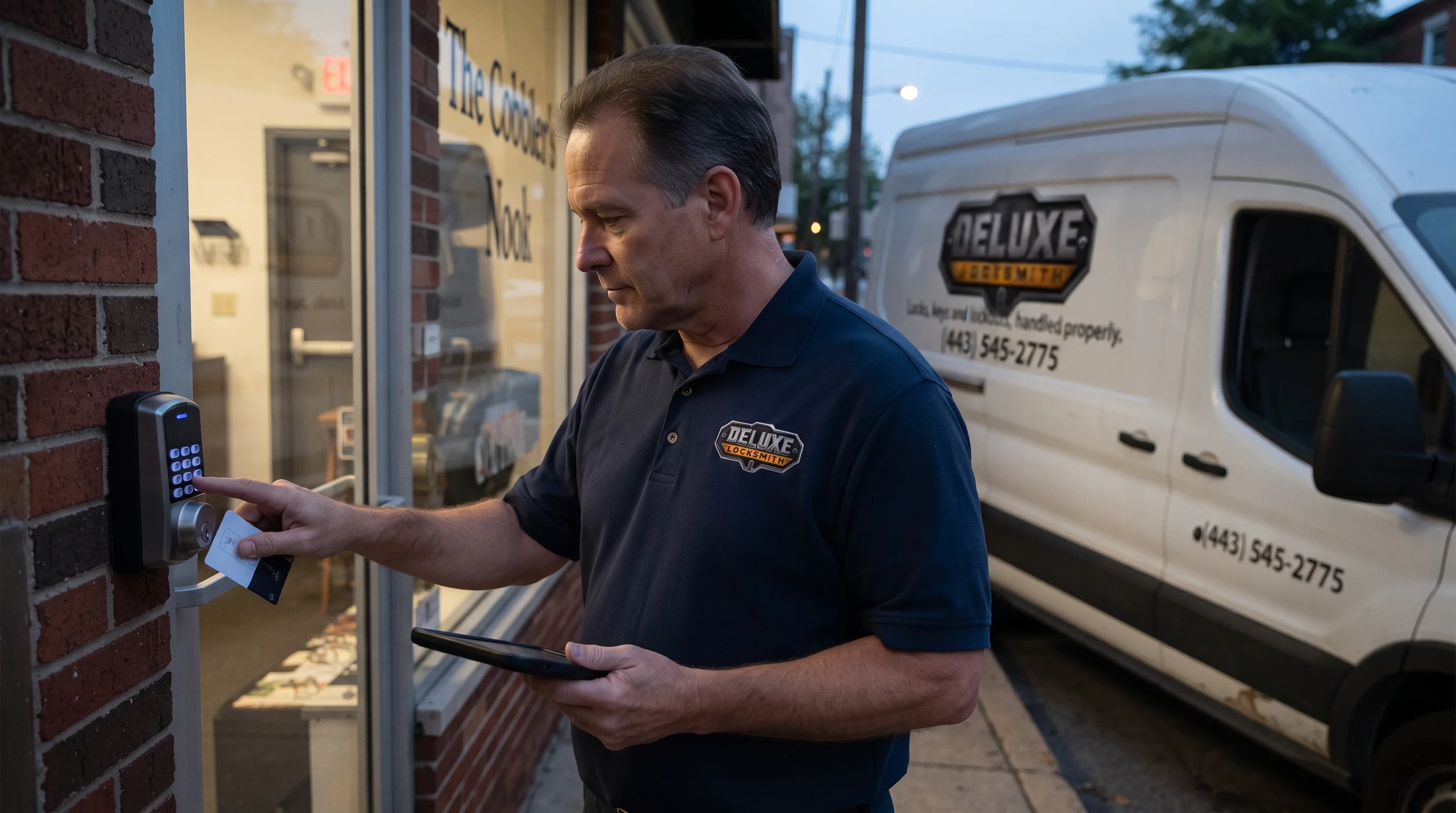
Sometimes, yes. Keyless entry earns its keep when keys have gotten out of hand, and it's a waste when they haven't. Staff who keep turning over, a stream of vendors, a manager asking who locked up last night: those are the signs. But three trusted people sharing one storefront door? Honestly, plain keys are probably fine.
Skimming? Here's the gist. Electronic access swaps copies of a metal key for credentials you can switch off, and it pays off when access changes a lot. It won't fix a flimsy door. A code everyone shares can't tell you who came in. And an exit door still has to let people out. Answer three quick questions below and you'll know which way to lean.
Key Takeaways
- You're buying control: end one person's access without new hardware or a hunt for copies.
- One shared code is easy, but it can't say who walked in. Give people their own.
- Exit-door hardware has to release with no more than 15 pounds of force under NFPA 101 (Decoded: Which doors need panic hardware?, I Dig Hardware, Allegion, 2026).
- Look for electrified locks certified to ANSI/BHMA A156.25 (A156.25 Electrified Locking Systems, BHMA, 2023).
On this page
- What is a keyless entry system?
- The 3-Question Keyless Test
- When are plain keys still the right call?
- Choosing a credential for your door
- What happens when the power goes out?
- Can you add electronic access to an exit door?
- What goes wrong after installation?
- What we check before recommending a system
- Frequently asked questions
What is a keyless entry system?
A keyless entry system is a lock that opens with something other than a metal key. Keypad code, card, fob, phone. You add a person, you take a person off, and the lock itself never gets touched. Some systems log every entry. The bigger ones tie a bunch of doors to one list, so a single person runs the whole building.
Honestly, "keyless" oversells it. Somebody still manages the credentials, and most buildings stash a metal key somewhere for emergencies. What changes is how many copies are floating around, and how fast you can cut someone off. We install several kinds, and our keyless entry systems page lists them.
The 3-Question Keyless Test
Whether it's worth it boils down to three questions. We call it the 3-Question Keyless Test. It works for a one-door shop and for an office with five.
- How often does access change? Count everyone who's held a key this year. Then count how many don't need one now. Seasonal help, cleaners, contractors, the delivery driver, the cousin who covered a weekend once... it adds up fast. Almost never? Keep your keys. Every few months? Keep reading.
- Do different doors need different answers? Owner gets everything. Cashier gets the front. A vendor gets the back door on Tuesdays, and that's it. Keys can't do that, so everybody gets the same yes.
- Do you ever need to know who came in? Usually this matters after something goes wrong. A break-in, a missing delivery, a fight over who forgot to lock up. A shared code leaves you guessing. Individual codes, cards and fobs usually don't.
Two or three yeses point toward electronic access. Zero or one points toward keys, done well.
When are plain keys still the right call?
Plain keys still win for one location, a small steady team and a door or two. They don't need power or software, they work in a blackout, and nobody has to learn anything new. A solid deadbolt with a restricted keyway can beat a fancier setup.
Not sure you need electronics at all? Often the real problem is that nobody knows who holds copies. Rekeying and moving to a restricted key system fixes that without any electronics, and we walk through how in our guide to master key systems for multi-door businesses.
Electronic access makes sense when the headache keeps coming back. Rekeying every time somebody leaves? That's the kind.
Choosing a credential for your door
Not every credential suits every business. Here's how the three common types compare on a small commercial door.
| Credential | How it works | What you can see afterward | Main weak spot | Best fit |
|---|---|---|---|---|
| Keypad code | Staff type a code | Nothing with one shared code. Per-person entry only if each person has their own | Codes get shared or written down | One or two doors, a few trusted staff |
| Card or fob | Staff tap a card or fob | Which credential opened which door, on systems that keep a log | Cards and fobs get lost | Several doors, or people who come and go |
| Phone credential | Staff open the door from an app | Which person entered, on systems that keep a log | Depends on phones and accounts staying current | Teams already run from a phone |
If you're unsure, start with a keypad that gives each person their own code. Cards and fobs make sense once you have more people and more doors. Phones are handy, though they add an app and an account to keep up. Whatever you choose, the lock should be commercial grade, sized to your door, and certified to ANSI/BHMA A156.25, the standard for electrified locking devices. BHMA keeps a directory of certified products (A156.25 Electrified Locking Systems, BHMA, 2023).
What happens when the power goes out?
An electric lock has to pick a side when the power dies. Fail-safe means it unlocks. Fail-secure means it stays locked. Neither is "better," you just need to choose on purpose.
A stockroom full of stock usually wants fail-secure, so a blackout doesn't leave the door hanging open. A door people rely on to get out of the building? Different story, and the next section covers it. Panic hardware still lets someone push through from the inside even when the outside is locked.
Most battery keypads keep a metal key override for dead batteries. Ask about it before you buy. Ask who changes the batteries, too, and how often. Then pull the plug, or the batteries, and test the door. An electric lock should never stop someone from leaving by hand (How to Install a Panic Bar, National Lock Supply, 2025).
Can you add electronic access to an exit door?
Yes, but this is where owners get tripped up. A door that needs panic hardware, the push bar people hit on the way out in an emergency, plays by tougher rules than an office door. NFPA 101 requires that hardware to be listed to ANSI/BHMA A156.3, the exit device standard, and the force to unlatch it can't top 15 pounds (Decoded: Which doors need panic hardware?, I Dig Hardware, Allegion, 2026).
Short version. Electronic access decides who comes in, and it never gets a say in who goes out.
If you're eyeing a keypad or badge reader on a door with a push bar, plan both at once. The 2024 code changed how an electric lock on a panic door can release, and an installer who only handles one half can get it wrong. We cover it in Does Your Cecil County Business Need a Panic Bar?, and our panic bar installation page covers the hardware itself.
What goes wrong after installation?
The hardware rarely fails first. The habits around it do.
Start with shared codes. One code for the whole crew works great until somebody quits, and then it's a copied key in disguise. Codes end up on sticky notes, too. Give everyone their own, or change the code every time a person leaves.
Lost cards and fobs come next, and every credential someone can lose needs a plan. That starts with knowing who holds each one. When one goes missing, switch it off the same day.
Then there's the owner problem. Pick one person to add and remove access. When everybody's in charge, nobody is, and people who left months ago are still on the list.
Fit matters. A lock that's perfect for a wood office door can flat-out fail on an aluminum storefront, where the frame, the glass and the swing of the door all get a vote.
And then there's wiring. A battery-only keypad is simple. Anything tied into power, a controller or your network needs an actual plan, because mistakes show up as flaky doors and gaps in the entry record.
What we check before recommending a system
We look at more than the lock. Door and frame come first, since new hardware has to fit what's already there. Wood, hollow metal and aluminum all behave differently. Aluminum storefront doors are the fussy bunch, because narrow stiles leave barely any room for a lock body. And how the door hangs matters. One that sags or drags will fight an electric strike every day.
After that, how many people need access, and how often that changes. Same three questions as the test, just out loud.
Most owners skip the end of the day. Who locks up? Who gets in at night? What happens when the power's off or a battery dies? If a system only works on a good day, it isn't finished.
A typical visit goes like this:
- Walk every door that will use the system. Note the door, the frame, and whether it's an exit.
- Settle who needs which door, and how that list is likely to change.
- Pick the credential and the power-loss behavior, door by door.
- Install, program and test each one, with the power off too.
- Leave you a plain list of who holds what, and how to add or remove someone.
Doors in Elkton or elsewhere in Cecil County? We do this on site. Our Elkton keyless entry page shows what that looks like locally.
Frequently Asked Questions
Are keyless entry systems secure?
Depends what you mean. The lock only does so much. A flimsy door or a soft frame beats any keypad, and one code shared by the whole crew isn't secure in any way that matters. Solid door, good lock, separate credential per person? That's hard to beat.
What happens to a keyless lock when the batteries die?
Usually you get a warning first, a blinking light or a beep, long before they quit. Plenty of locks keep a regular key cylinder as a backup too. Have your installer show you the override, and put battery swaps on somebody's calendar. A dead-battery lockout is the avoidable kind.
Can I add keyless entry to a door with a panic bar?
Often, yes. People still need to walk out with no key, no code and no thinking, though, and your local code spells out how the release works. Hold off on buying. Have someone who knows exit hardware look at the door first, since the bar and the lock need to work as one setup.
Do I still need to rekey if I switch to keyless entry?
On the doors the system covers, usually no. You delete the person. The leftovers are the catch: a back office, a storage closet, anything still on a mechanical lock. Rekey those so the old keys quit working there too.
Is keyless entry worth it for a business with only one door?
Maybe. Staff coming and going, or wanting a record of who's been in? Then yes. Just you and two people you'd trust with your house? A good deadbolt does fine. Try the 3-Question Keyless Test and see where you land.
Not Sure Which Side of the Line You're On?
Call (443) 545-2775 and tell us about your doors and your staff. Or send the details through the request form and we'll call you back. We cover Northeast Maryland & Delaware, and we'll say so if keys will do the job.
Where we do this
We cover Northeast Maryland & Delaware. If you want the detail for your own town rather than the general advice above, start here:
- Locksmith in Elkton, MD
- Locksmith in North East, MD
- Locksmith in Rising Sun, MD
- Locksmith in Perryville, MD
Sources
- I Dig Hardware (Allegion), Decoded: Which doors need panic hardware?, retrieved 2026-10-09, idighardware.com
- Builders Hardware Manufacturers Association, A156.25 Electrified Locking Systems, retrieved 2026-10-09, buildershardware.com
- National Lock Supply, How to Install a Panic Bar: Exit Device Steps and Mounting Height, retrieved 2026-10-09, nationallocksupply.com
Deluxe Locksmith is a locally owned and operated mobile locksmith serving Elkton, MD and the surrounding Cecil County, Harford County, New Castle County, and Kent County area. Bonded and insured, with technicians dispatched directly to the job site for automotive, residential, commercial, and emergency lock and key work. Read more about the team on the About page.