
Building access control spending will hit $60.4B by 2035. Here is what a master key system actually solves, and when it does not.

A master key system lets one key open every door in a building. Individual keys still work on their own doors only. That's the short version. The longer version is where most businesses get it wrong. Some install more than they need. Others stick with a pile of individual keys long after the building outgrew that approach.
Skimming? Here's the gist. More than a handful of interior doors? Staff turnover, or more than one person needing different room combinations? A tiered master key system is usually worth it. A single office with two doors and the same three people for years? It usually isn't. Deluxe Locksmith installs and services master key systems across Cecil County, Maryland, including Elkton, North East, Rising Sun, and Perryville.
What Does a Master Key System Actually Do?
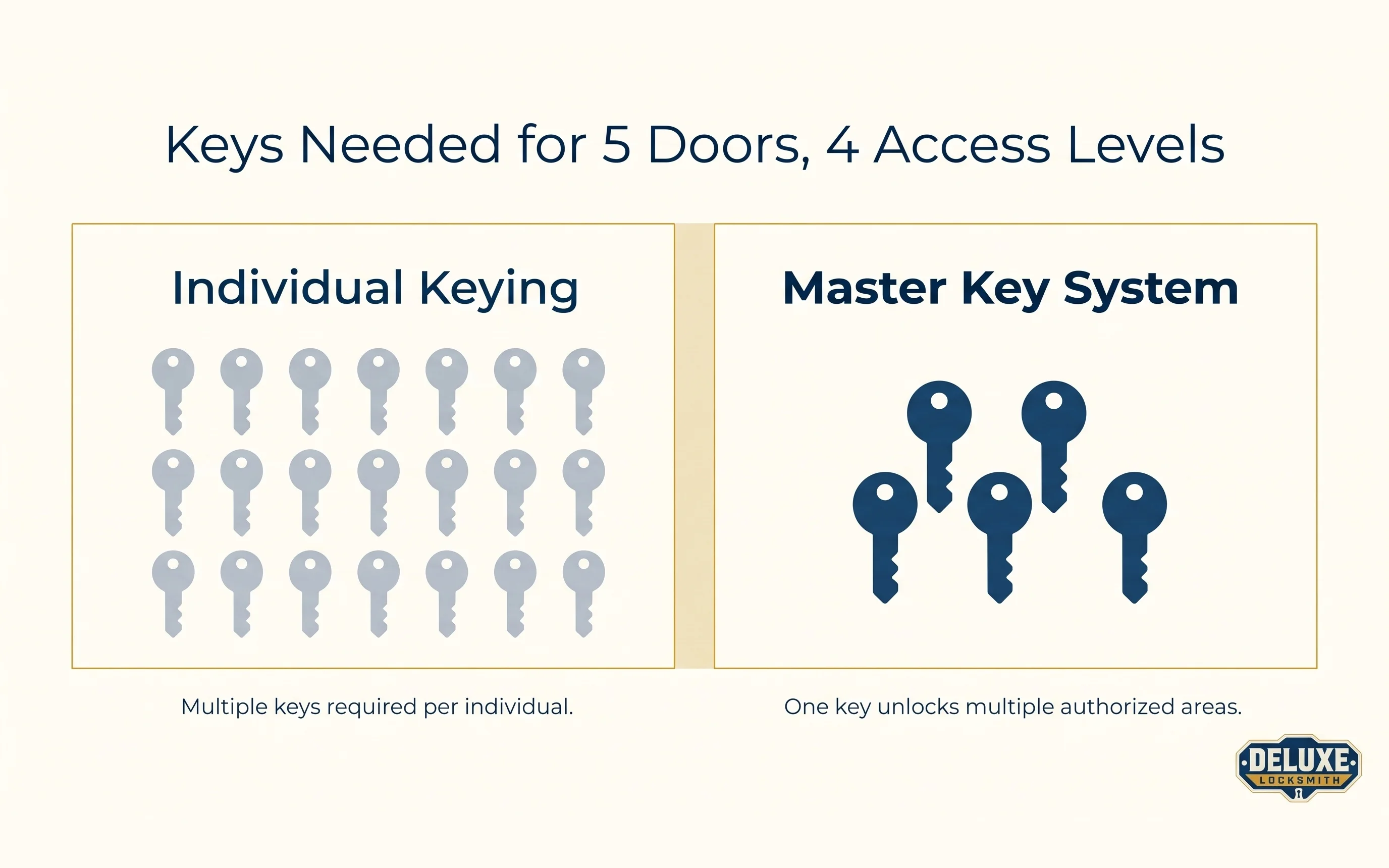
A master key system uses a tiered set of cylinders. One master key opens every door. Sub-master keys open groups of doors. Individual change keys open only their assigned door. In 2026, that structure fits most commercial properties with more than 4-5 interior doors and multiple staff roles. It beats a copy of every key for every person.
The point isn't convenience for convenience's sake. It's separation. A manager might need the office, the stock room, and the front door. A part-time employee might only need the front door. Without tiering, giving that manager the right access usually means giving everyone the same access. Cutting individual keys for every combination gets unmanageable fast.
People tend to think of master keying as an all-or-nothing upgrade. It isn't. A two-level setup, one master plus a handful of change keys, solves the problem for a small office. A three- or four-level structure with sub-masters by department fits better on a property with distinct zones. Think a warehouse with an office, a loading area, and a secured inventory room. Match the tiering to how the building actually gets used, not the other way around.
Master Key vs. Rekeying: Different Problems
Rekeying and master keying get confused often. Mixing them up wastes money. Rekeying changes the pins in an existing lock, so old keys stop working. It's useful after a lost key or an employee departure. A master key system is different: a structural decision about who can open what, built once and adjusted as roles change.
If your business just needs old keys deactivated after someone leaves, that's commercial lock rekeying, not a new plan. If you're constantly juggling who has which key and the answer keeps getting messier, that's the sign you need a tiered structure.
Restricted Keyways and the Cross-Keying Trap
Standard keyways can be duplicated at any hardware store or kiosk. A restricted keyway uses a patent-protected key blank that only a licensed locksmith can cut, which closes off the easiest way an unauthorized copy gets made. For a master key system, that matters more than it does for a single lock: one uncontrolled copy of a master doesn't just open one door, it opens all of them.
There's a failure mode worth knowing about too: cross-keying. It happens when a system gets stretched past its original design, usually one exception at a time. A manager needs access to a room outside their normal level, so a tech pins a workaround instead of restructuring the hierarchy. Do that enough times over a few years and the master key stops meaning what it's supposed to mean. Anyone who's inherited a messy key system knows the sign: nobody can explain anymore why a certain key opens a certain door. The fix is a proper re-master, not another one-off exception. If a system already feels like that, treat it as a sign the structure needs rebuilding, not patching again.
Why Does Key Control Matter for a Multi-Door Business?
U.S. voluntary employee turnover averaged 13% in 2025, down from 24.7% in 2022 (Mercer's 2025 US Turnover Survey, 2025). Still meaningful for any business with more than a few employees. Every departure without a clear rekey policy leaves a key in circulation that nobody is tracking anymore.

We see this most often with businesses that have been in the same location for years. Nobody remembers exactly how many keys were cut. Nobody's sure who still has one, or whether a contractor from three years ago ever returned theirs. By the time someone asks the question, the honest answer is usually "we don't know." That's precisely the situation documented key control prevents.
A properly set up system comes with a schedule: a written record of which key level opens which doors, and who was issued one. That record is what makes it possible to answer "who can get into the server room" without guessing.
When Is a Master Key System Overkill?
A master key system is overkill for a small building. Think one or two doors, a small stable staff, no meaningful separation needed between roles. If everyone already needs access to everything, tiering just adds paperwork without solving a real problem.
The FBI recorded 779,542 burglaries nationwide in 2024, the lowest count in decades (Crime in the United States, FBI, 2024 data). Residential properties made up roughly 52% of that total, so commercial properties account for close to half. That risk exists regardless of building size. But the response to it should scale with the building. A single-office business is usually better served by solid commercial lock hardware and a straightforward rekey policy than by a multi-tier setup it doesn't need.
How Do You Know Which Level of System Fits Your Business?
The right level depends on how many distinct access groups exist, not how many doors there are. A five-door building with one access group, everyone can go everywhere, needs a simple setup. A three-door building with a manager, hourly staff, and a cleaning contractor needing different combinations needs tiering anyway, even with fewer doors.
Start by listing who needs access to what. Go role by role, not door by door. Once that list exists, the number of key levels usually becomes obvious. It's also worth asking whether every space needs its own physical key. An electronic point might make more sense for one or two high-traffic doors, while the rest stay on a traditional setup.
A Simple Way to Think About It
| Business situation | Likely fit |
|---|---|
| 1-2 doors, small stable staff, everyone needs the same access | Standard keying, no master system |
| 3-6 doors, a few access groups (manager, staff, contractor) | Two- or three-level master system |
| 7+ doors, multiple departments, frequent staff changes | Multi-level master system with a documented key schedule |
| High-traffic single entry needing audit trail | Consider electronic access for that door, keyed master for the rest |
What About Businesses With More Than One Location?
A business running two or three sites usually wants two things that pull in opposite directions: a manager who can move between locations without carrying separate rings, and a guarantee that a key from one site can't open doors at another. A grand master key structure handles both. Each location keeps its own master level, and one grand master sits above all of them for whoever needs cross-site access. The key schedule just needs an extra column for location, not a whole separate system per site.
Master Keying and Life-Safety Hardware
Master keying doesn't happen in isolation from the rest of a door's hardware. Exit routes on commercial buildings often need panic bar hardware to meet code, and a poorly matched cylinder can interfere with how that hardware latches and releases. Anyone setting up a master system on a building with panic-hardware exits should have both pieces looked at together, not as two separate jobs scheduled months apart.
Frequently Asked Questions
Can a master key system be added to locks I already have?
Often, yes. Many commercial cylinders can be re-pinned to fit a new tiered structure without replacing the entire lock body. That keeps the work focused on the pins and keying. No tearing out hardware that still works (The Benefits of a Master Key System in a Commercial Building, HOPPE, accessed 2026).
What happens if a master key gets lost?
That's a real problem, because a lost master can open every door under it, not just one. The fix is usually rekeying every lock under that master to a fresh keying. That's exactly why access to masters should stay limited to the smallest group of people who genuinely need it.
How is a master key system different from an electronic access system?
A master key setup is entirely physical: no batteries, no software, no network dependency. An electronic system adds audit trails and remote deactivation, but depends on power and software to keep working. Many multi-door businesses use both, electronic access on one or two high-traffic doors, a physical master system for the rest.
Do I need a master key system if I only have three employees?
Not necessarily. If all three need the same access and the building has one or two doors, a standard rekey after any departure usually covers the risk. A tiered structure earns its place once access actually needs to differ by role.
Getting a System Set Up
Not sure whether your building needs a two-level setup or something more layered? The starting point is the same either way: a walk-through of the doors, the roles, and who currently has keys to what. Deluxe Locksmith handles that assessment on-site across Elkton and the rest of Cecil County. Then it's a schedule: a written record of who can open what.
On-site, that usually means counting doors, checking what's already installed, and asking who needs into which spaces. Have a rough headcount and department breakdown ready. It speeds things up. For a straightforward two- or three-level setup, most of that assessment happens in a single visit. A larger, multi-department property might need a second pass to get the grouping right before any cylinders get pinned.
A key schedule isn't a one-time document either. Staff change, departments get added, and a level that made sense two years ago might not fit the business today. Worth a quick review any time roles shift significantly, not just when a key goes missing.
Where we do this
We cover Northeast Maryland & Delaware. If you want the detail for your own town rather than the general advice above, start here:
- Locksmith in Elkton, MD
- Locksmith in North East, MD
- Locksmith in Rising Sun, MD
- Locksmith in Perryville, MD
Need this doing rather than reading about?
Call (443) 545-2775 and describe what is happening, or send the details through the request form and we will call you back. We cover Northeast Maryland & Delaware.
Deluxe Locksmith is a locally owned and operated mobile locksmith serving Elkton, MD and the surrounding Cecil County, Harford County, New Castle County, and Kent County area. Bonded and insured, with technicians dispatched directly to the job site for automotive, residential, commercial, and emergency lock and key work. Read more about the team on the About page, or check common questions on the FAQ.