
A rekey fixes who can open a door, not a worn lock. Start with a three-count key audit and the right fix follows.
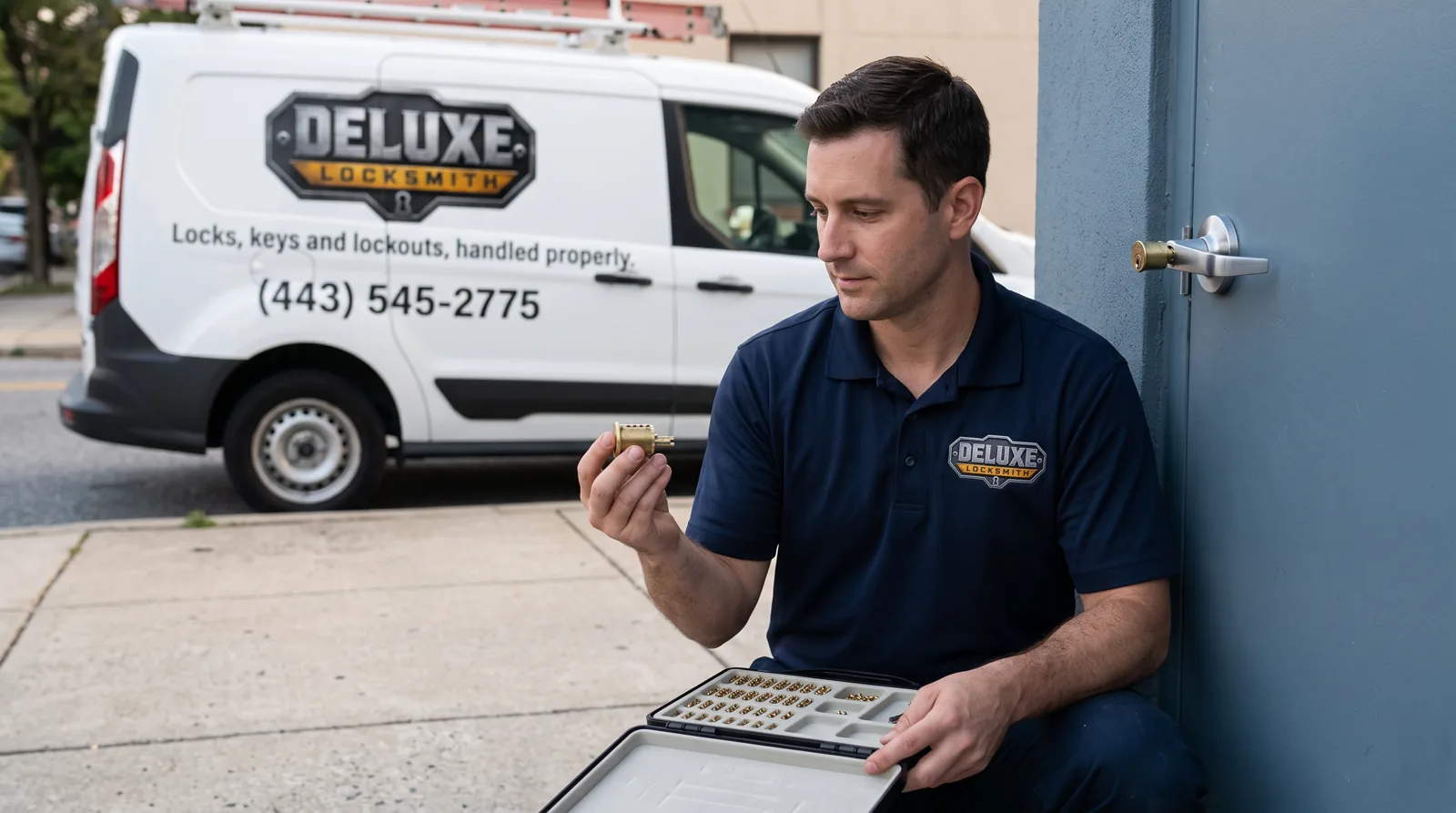
A commercial rekey is the right fix when you can name a key that is out of your control and the lock itself still works well. If the hardware is worn, or if you can't say who holds which keys, a rekey alone won't solve the problem. So start with a key audit that takes a few hours and tells you whether to rekey, replace the lock, or move a door to electronic access.
Skimming? Here's the gist. Count the keys you handed out and the keys you got back, then find out which doors share a master. If any key is missing and the lock turns smoothly, rekey that door, and each door the missing key opens. If the lock sticks or wobbles, fix the hardware first. If people come and go each month, look at electronic access for the busiest door.
Key Takeaways
- A rekey changes the pins inside the cylinder so old keys stop working, while the lock hardware on the door stays in place.
- The size of a rekey depends on the highest level of key that is missing. A lost change key affects one door, and a lost master key affects all the doors under it.
- Rekeying each time someone leaves isn't always easy, but rekeying right after an unreturned key or a bad exit often is.
- ANSI/BHMA A156.28 is the industry's recommended practice for keying systems and key management (BHMA, A156.28-2023 Recommended Practices for Mechanical Keying Systems). It is a recommended practice, not a law.
On this page
- What does a key audit actually check?
- When is a commercial rekey the right fix?
- When is rekeying the wrong fix?
- Should you rekey, replace, or go electronic?
- What does a lost master key really mean?
- What should you ask a locksmith before booking?
- Frequently asked questions
What does a key audit actually check?
A key audit is a written list of each door, each key that opens it, and each person who holds one of those keys. Most small businesses have never made one, even though keys go out over the years, a few get copied, and no one writes it down.
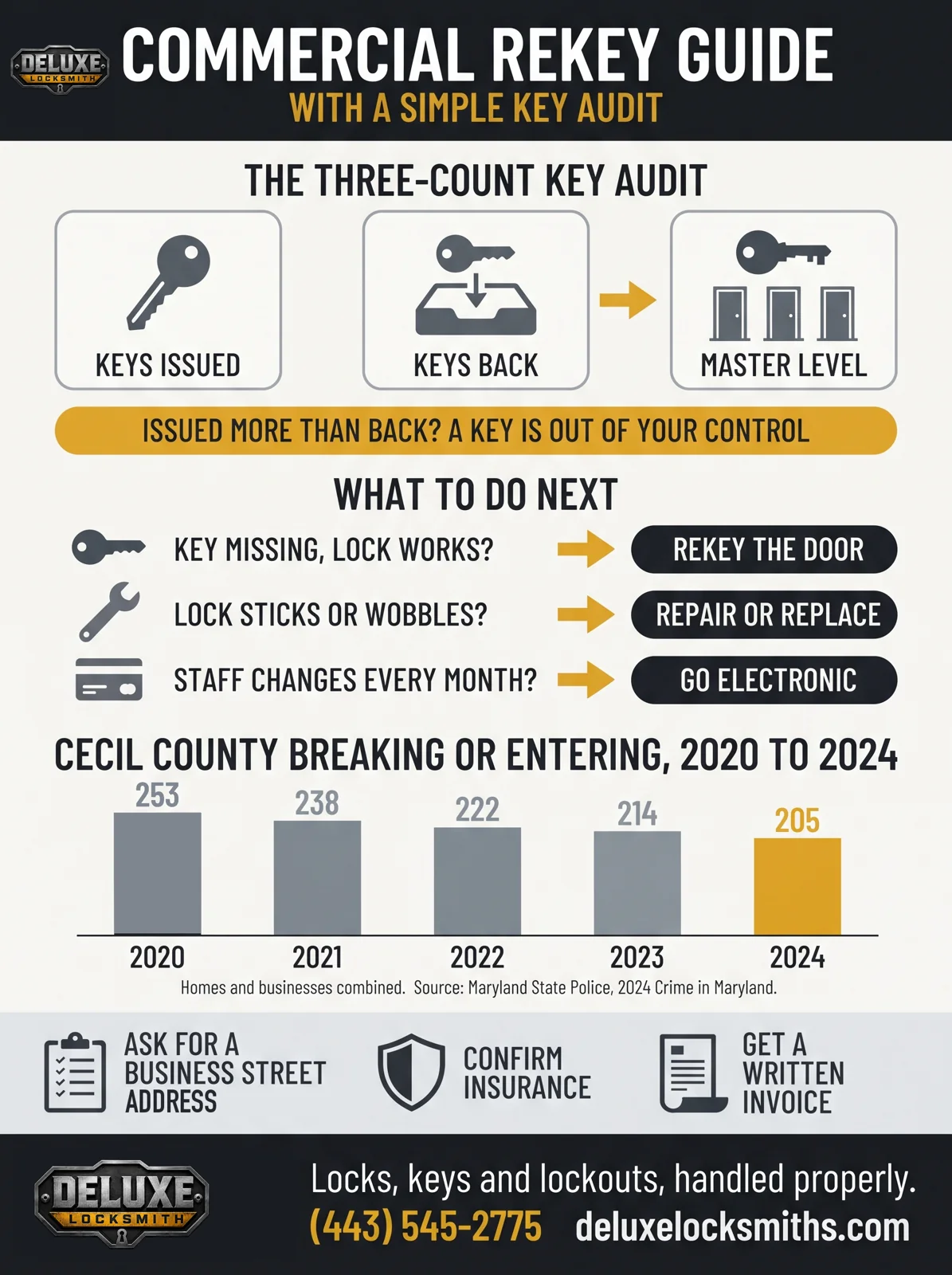
The risk is real here, since the Maryland State Police counted 205 breaking or entering offenses in Cecil County in 2024, down from 253 in 2020, and 10,932 statewide. That total covers homes and businesses combined, so it does not separate out commercial break-ins. (Maryland State Police, 2024 Crime in Maryland, Breaking or Entering by County, page 15; data retrieved 2026-10-18.)
We call the quick version the Three-Count Key Audit, and it comes down to three numbers for each door.
- Keys issued. How many keys to this door have ever gone out? Include spares in desk drawers and the one the cleaning crew has.
- Keys back. How many of those can you put on the table today?
- Master level. Does a master or sub-master key also open this door? If yes, each holder of that master counts too.
If the first number is bigger than the second, you have a key out of your control, so write the counts down as a table that looks like this.
| Door | Keys issued | Keys back | Opened by a master? | Last rekeyed | Notes |
|---|---|---|---|---|---|
| Front entrance | 6 | 5 | Yes | Unknown | Former shift lead never returned key |
| Back delivery door | 3 | 3 | Yes | 2025 | Vendor key returned |
| Office | 2 | 2 | Yes | Unknown | |
| Stockroom | 4 | 3 | No | Unknown | One spare missing |
In this example, the front entrance and the stockroom each have a missing key, and because the front entrance is also on the master, the master holders matter too.
If your doors sit on a master system, our guide to master key systems for multi-door businesses explains how the levels fit.
When is a commercial rekey the right fix?
A commercial rekey is the right fix when the lock works and the problem is who can open it. Rekeying swaps the pins inside the cylinder for a new combination, so the old keys stop working. The handles, the lock body and the door prep all stay where they are.
Rekeying makes sense right away when:
- A key was never returned. An employee, contractor or former tenant still has one.
- Someone left on bad terms. Even if they gave the key back, they may have made a copy first.
- A master key went missing. All the doors that master opens are at risk.
- A vendor had broad access. A remodeling crew or a short-term service company no longer needs it.
- You took over a space. You don't know how many keys the last tenant handed out.
Routine rekeys are a judgment call, and your audit is a better guide than a calendar. If the counts match and no one left badly, you can often wait.
When is rekeying the wrong fix?
Rekeying changes who can open a lock, but it doesn't fix the lock. If the hardware is the real problem, a rekey just gives you new keys for a lock that is still failing.
Check for these before booking a rekey.
- The key turns hard, or only works when you jiggle it.
- The cylinder feels loose, or spins in the door.
- Does the latch catch only when someone pulls the door shut?
- Staff prop the door open because it won't close on its own.
- There was a break-in attempt.
Any of these points to commercial lock repair or a new lock first, and a door that won't close on its own is often a closer problem more than a lock problem.
Should you rekey, replace, or go electronic?
The answer depends on what your audit found, and this table covers the common cases.
| What the audit found | Best fix | Why |
|---|---|---|
| One key missing, lock works well | Rekey that door | Fastest way to cut off the missing key |
| A master key missing | Rekey at the master level | All the doors under that master are at risk |
| Lock sticks, wobbles or was damaged | Repair or replace, then key it | A rekey won't fix worn hardware |
| Staff or vendors change each month | Electronic access on busy doors | Credentials can be shut off the same day |
| Card or code system plus a few metal keys | Disable credentials, rekey the keyed doors | Covers both ways in |
| Counts match, no one left badly | Wait, recheck in a few months | No key is out of your control |
Electronic access deserves a closer look if turnover keeps forcing rekeys. With a card or code system, you can switch off a departing employee's credential without touching the lock. Our breakdown of whether keyless entry is worth it for a small business walks through when that pays off and when plain keys still win. Most businesses that add keyless entry systems keep at least a few keyed doors, and those still need a rekey when a key goes missing.
What does a lost master key really mean?
A lost master key is the most serious result an audit can turn up. A master opens each door beneath it in the system, and whoever finds it can open all of them.
The scope of the fix depends on the level. When a master key is lost, a locksmith often rekeys the locks at the master level and issues new master keys. Lower-level change keys may keep working, depending on how the system was designed. A locksmith needs to see the key schedule, or rebuild one, before saying which cylinders change.
Some businesses plan for this in advance, using rekeyable or interchangeable cores that let a cylinder be changed quickly without pulling the whole lock.
The bigger lesson is key control. Limit master keys to the people who truly need them, use keys that can't be copied at a hardware store, and keep the audit table current. The Maryland Community Crime Prevention Institute's commercial security survey makes the same point. It recommends that a minimum number of people hold or can access keys, and that businesses keep spare keys in a secured cabinet or vault (Maryland Community Crime Prevention Institute, Commercial/Industrial Security Survey). Our master key systems service covers designing or cleaning up a system so a single lost key causes less damage.
What should you ask a locksmith before booking?
Ask these up front so a rekey stays the size it needs to be.
- Is this a master-keyed system? If yes, ask which levels change and which keys will still work.
- Can the existing cylinders be rekeyed? Most can. Some older or high-security cylinders need parts or replacement.
- Will you check the hardware while you're there? A rekey is a good time to catch a loose cylinder or a latch that doesn't line up.
- Do you start with non-destructive methods? If keys are lost entirely, ask how the lock will be opened before anything is drilled.
- How is the job quoted? Commercial rekeys are often quoted per job, depending on the number of cylinders and the key system.
Maryland's locksmith licensing law defines rekeying as locksmith work (Maryland Code, Business Regulation § 12.5-101). Maryland's Department of Labor makes the same point about checking the provider. It advises asking each locksmith for a business street address, which shows whether they work as a mobile service, from home, or from a storefront. Ask about insurance too. The state's guidance also covers the invoice. It should show the quoted price, the type of lock serviced, the amount paid, the service address, and the locksmith's license number (Maryland Department of Labor, Maryland Locksmith Consumer Advisory).
Have your audit table ready when you call. It answers most of what a locksmith will ask.
For businesses in Elkton and across Cecil County, our commercial lock rekeying in Elkton is done on site at your building. Outside Elkton, the main commercial lock rekeying page lists each town we cover.
Frequently asked questions
How often should a business rekey its locks?
Rekey right after a key goes missing, someone leaves on bad terms, or you take over a new space. Otherwise, a current key audit is the better guide, because it shows whether any key is actually out of your control.
Can you rekey only some of the doors?
Yes, a rekey can be limited to the doors a missing key opens. On a master-keyed system, the locksmith checks which levels that key belongs to and changes only those cylinders. Doors the missing key never opened can stay as they are, along with the keys people carry now.
If a master key is lost, do all the locks need rekeying?
Often the locks under that master need to change at the master level, and the locksmith issues new master keys. Whether each individual change key also changes depends on how the system was set up. A locksmith needs to see or rebuild the key schedule before saying which cylinders are affected.
Is rekeying enough if we already use key cards?
Not always. Disabling a former employee's card or code handles the electronic doors the same day, but any door that still uses a metal key needs its own check. If someone left with a physical key to a keyed door or a key override, that door still needs a commercial rekey.
Does rekeying change how my door hardware looks?
No. A rekey changes the pins inside the cylinder, not the lever, knob, handle or trim, so the door looks the same afterward and only the keys change. Putting in new hardware is a separate job, and a locksmith can key it to the new system at the same time.
Getting the audit done
Start with the three counts, door by door. If the counts don't match, or no one knows the answers, that's the point to call.
Deluxe Locksmith handles commercial rekeys on site across Elkton and the rest of Cecil County, plus Harford County in Maryland and New Castle and Kent Counties in Delaware. Each job is quoted per job. Call (443) 545-2775 or request service online, and have your audit table handy.
Where we do this
We cover Northeast Maryland & Delaware. If you want the detail for your own town rather than the general advice above, start here:
- Locksmith in Elkton, MD
- Locksmith in North East, MD
- Locksmith in Rising Sun, MD
- Locksmith in Perryville, MD
Deluxe Locksmith is a locally owned and operated mobile locksmith serving Elkton, MD and the surrounding Cecil County, Harford County, New Castle County, and Kent County area. Bonded and insured, with technicians dispatched directly to the job site for automotive, residential, commercial, and emergency lock and key work. Read more about the team on the About page, or check common questions on the FAQ.